Products
Please click on specific product for details)
|
ELCID (Electromagnetic Core Imperfection Detection) Evolution
Electromagnetic Core Imperfection Detection (EL CID) testing is accepted world-wide for reliable and safe detection of stator core inter-laminar faults (CIGRE, 2004)."
Originally developed by the CEGB in England, the EL CID Evolution is a third generation instrument that is proven, reliable and easy to use. The EL CID Evolution tests the condition of a stator core in less time and with fewer resources than the earlier EL CID models.
The ELCID instrument can be used to test turbo-generators, hydro-generators, and large motors.
![]() |
|
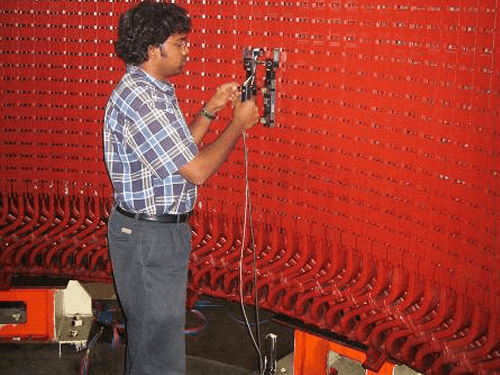
EL CID operates at only 4% of normal operating flux. This low flux is generated by a portable, quickly installed excitation kit. Any imperfection in the core inter-laminar insulation produces fault currents, which are detected by a Chattock coil and analyzed by the EL CID signal-processing unit. Measurement results are digitally stored in a laptop for analysis and report generation to precisely locate the faults in the stator core. Future results can be compared to past results for trend analysis.
The Robotic Inspection Vehicle (RIV) compliments the EL CID Evolution, and is ideally suited to test large stator cores. Having the capability to follow automatically the edge of stator teeth, the RIV carries the Chattok, thereby significantly reducing operator fatigue. This also increases the speed of testing.
Powertest Asia offers EL CID generator testing services, as well as a complete training course on the use and operation of the EL CID Evolution instrument.
Robotic Inspection Vehicle
The Robotic Inspection Vehicle is a low profile (30 mm/11⁄4") magnetically supported robotic vehicle that can carry the Chattock of the EL CID stator core fault test equipment along the stator core of an electric generator or a large electric motor. The automated scanning at a fixed speed provides easier testing and more consistent results than an EL CID core fault test performed manually. Leading OEM's and power utilities have successfully used the RIV on large generators for EL CID testing and to carry other transducers such as mini-cameras and Wedge Tightness Detector probes.
![]() |
Wedge Tightness Detector
The WTD-501 instrument is an improved version of the original WTD-123. Generator testing with the WTD-501 instrument quickly and objectively measures the relative tightness of all stator wedges in a machine. The redesigned probe is small, light and adjustable to fit most rotating machines, regardless of slot size or depth.
![]() |
Stator wedges were traditionally tested for tightness by tapping them with a hammer and listening to the sound produced. Electronic stator wedge tightness detection is faster, more accurate, provides more consistent results than hand tapping methods, and the test procedure is repeatable. The WTD Model 501 can be used to test all types of generators and motor stator wedges, including those with ripple springs.
Loose stator wedges may lead to vibration and erosion of stator insulation in electric generators. These serious problems can cause generator failure. The WTD acts as a sophisticated electronic ear that quickly and reliably provides an electronic map of wedge tightness.
The tightness of each wedge is compared to all other wedges in the winding, the wedges of another winding or an absolute external reference. A colored map showing the relative tightness of every wedge in the stator is produced and the data can be stored for trend analysis to determine when maintenance will be required.
DC Ramp Test Set
The DCR-50 instrument provides a safer off-line test of stator winding insulation compared to a DC or AC hipot test. It can identify problems in the stator winding insulation before an unexpected in-service failure, unlike the pass/fail of a dc or ac hipot test.
![]() |
An automatically ramped or manually stepped direct voltage (up to 50 kV) is applied to the stator winding and the resulting current is measured and plotted against voltage. Examination of the current versus voltage curve allows assessment of stator insulation condition, as well as diagnosis of damage, defects, and deterioration mechanisms. The DCR-50 allows tests to be performed in accordance with IEEE Std 95-2002.
The test results are repeatable and accurate. This test can frequently identify stator insulation windings that are approaching failure, without accelerating the deterioration process. It can take less than an hour to perform. The DC Ramp Test method has been proven for motor and generator insulation testing for many years by the US Bureau of Reclamation and others. It is applicable to asphalt, polyester and epoxy-mica insulation systems.
Partial Discharge Monitoring Systems
PDA Couplers specifically designed to detect partial discharge activity from hydro generator stator windings.
Whether it’s the epoxy-mica or cable type, these couplers are permanently installed at specific locations on the stator winding to optimize electrical noise / partial discharge pulse separation.
PDA couplers detect stator winding PD activity. In the last two decades Epoxy Mica Capacitors (EMCs) have become the industry’s choice due to reliability and the relative ease of installation. EMCs installation usually requires about 3 to 4 days of effort per machine. Typically, on machines rated less than 100 MW, only 6 couplers are installed. On large machines, sometimes more than 6 PDA couplers are installed. The standard package includes a set of 6 couplers, a termination box and installation hardware.
![]() |
![]() |
The Corona Probe (originally known as the TVA probe) is used to locate partial discharge in each slot with the winding energized phase by phase. It supplements on-line partial discharge monitoring. The PPM-97 probe is generally used on motors and generators with rated voltage greater than 6 KV
Rotor
The DCR-50 instrument provides a safer off-line test of stator winding insulation compared to a DC or AC hipot test. It can identify problems in the stator winding insulation before an unexpected in-service failure, unlike the pass/fail of a dc or ac hipot test.
- Flux Monitor
The Flux probe instrument is a sophisticated on-line monitor to remotely acquire magnetic flux data from air gap mounted flux probes in synchronous motor and generator rotors. Air gap flux monitoring is a proven tool used to provide information on the integrity of the rotor winding inter-turn insulation. This information is critical in planning maintenance, explaining abnormal vibrations and verifying new and rewound rotor integrity.
Traditionally, portable instrumentation has been used to acquire magnetic flux signals from probes permanently mounted on the machine stator. The Flux probe system consists of a permanently connected Flux probe acquisition device which is mounted in the plant and can be connected to probes from up to four generators.
This instrument includes user-friendly Windows™ acquisition software, which is used to store data from any of the four inputs on demand. Using generator load information, the Flux probe instrument can automate your magnetic flux measurements, freeing you from traveling to the plant, or having to be available during hard-to-schedule generator run-ups.